By Kelly Renz
There is a breakthrough concept that businesses miss over and over.
Many business owners believe their next breakthrough will come from finding the right person. A stronger executive. A better manager. A more experienced COO. A unicorn that will solve all the problems.
While people matter most when it comes to a healthy business, I have learned something after years of working with leadership teams: most organizations do not struggle because they lack talented people. They struggle because talented people are operating inside a system that creates confusion, lack of accountability, overlap, and inconsistency.
That is one reason Cameron Herold’s book, The Second in Command, resonates with so many leaders. The book explores the relationship between a CEO and a second-in-command and highlights the power of alignment, trust, and accountability between those two roles.
But there is a larger lesson hiding beneath the surface.
A strong second-in-command is not a substitute for an operating system.
The Real Problem Is Rarely the Person
When leaders describe their challenges, they often sound like people problems:
- “My team isn’t accountable.”
- “My leaders aren’t aligned.”
- “Everyone keeps bringing decisions back to me.”
- “My COO is overwhelmed.”
- “My managers are operating in silos.”
The natural assumption is that someone needs to perform better.
Sometimes that is true. More often, however, the issue is structural.
People cannot consistently succeed when:
- Roles are unclear
- Decision rights are undefined
- Priorities constantly shift
- Metrics are disconnected from strategy
- Meetings create activity instead of accountability
Without clarity, even great leaders struggle.
The Business Becomes Dependent on Heroics
Many organizations eventually create an unofficial operating model built around a few key people. The CEO becomes the decision-maker for everything. The COO becomes the firefighter. The leadership team waits for direction. Progress happens through effort rather than process.
At first, this can feel productive. Over time, it becomes exhausting.
Growth slows. Decision-making bottlenecks emerge. Leaders burn out.
The organization becomes dependent on individuals rather than a system.
That is not scalability. That is vulnerability.
The Best Second-in-Command Wants a Better System
One of the most interesting themes in The Second in Command is that great operational leaders create leverage. They build structure, establish accountability, create consistency, and help the organization execute.
But even the strongest COO cannot carry an organization alone.
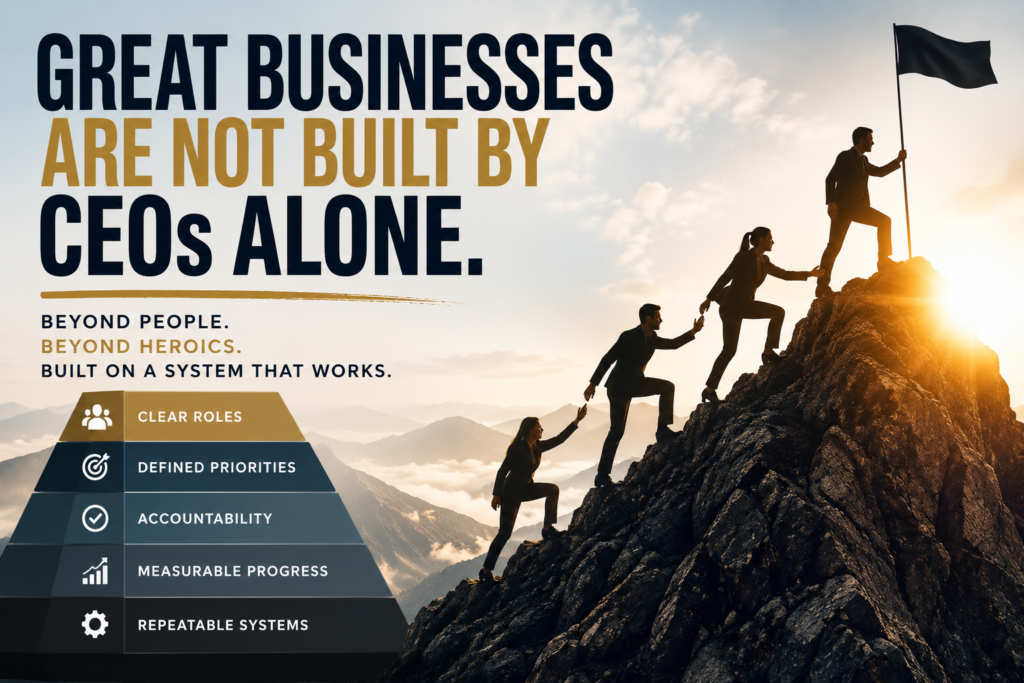
What creates sustainable performance is a business operating system that gives leaders clarity around:
- Who owns what
- How decisions are made
- What priorities matter most
- How progress is measured
- How accountability is reinforced
When those elements exist, the CEO and second-in-command become exponentially more effective.
Why This Matters
At inVantage, we often tell leadership teams that every company already has an operating system. The question is whether it is intentional or accidental.
An accidental operating system relies on personalities.
An intentional operating system relies on clarity, accountability, and repeatable processes.
That distinction becomes increasingly important as organizations grow because growth amplifies whatever system already exists.
If confusion exists, growth creates more confusion. If accountability is weak, growth exposes it. If alignment is missing, growth makes it impossible to hide.
The View from the Summit
The strongest organizations are not built around a heroic CEO. They are not built around an exceptional COO. They are built around a leadership team operating from a shared framework that creates clarity, consistency, and accountability.
People matter. Leadership matters. But neither reaches its full potential without a system that supports execution.
That may be the most important lesson from The Second in Command.
The goal is not simply finding the right second-in-command. The goal is creating an organization where every leader can succeed because the operating system makes success repeatable.